Tuesday, January 18, 2011

Laura Linney to return to Broadway following loss


NEW YORK – Laura Linney was to return to Broadway's "Time Stands Still" on Tuesday night for the first time since her father's death.
Romulus Linney, a prolific playwright, died Saturday in upstate New York.
The actress dropped out of the play over the weekend. She wasn't on hand to accept her Golden Globe award Sunday night for her role in Showtime's "The Big C."
Linney returns for the final weeks of "Time Stands Still," which closes Jan. 30 at the Court Theatre on 48th Street. The play also stars Brian d'Arcy James, Eric Bogosian and Christina Ricci.
The marquees of Broadway theaters are to be dimmed Wednesday in honor of Romulus Linney and producer Ellen Stewart, who died last week.
Source: Yahoo News

Researchers aim to resurrect mammoth in five years

TOKYO (AFP) – Japanese researchers will launch a project this year to resurrect the long-extinct mammoth by using cloning technology to bring the ancient pachyderm back to life in around five years time.

The researchers will try to revive the species by obtaining tissue this summer from the carcass of a mammoth preserved in a Russian research laboratory, the Yomiuri Shimbun reported.

"Preparations to realise this goal have been made," Akira Iritani, leader of the team and a professor emeritus of Kyoto University, told the mass-circulation daily.

Under the plan, the nuclei of mammoth cells will be inserted into an elephant's egg cell from which the nuclei have been removed, to create an embryo containing mammoth genes, the report said.

The embryo will then be inserted into an elephant's uterus in the hope that the animal will eventually give birth to a baby mammoth.

capt.photo_1295251212835-1-0.jpg (399×266)

The elephant is the closest modern relative of the mammoth, a huge woolly mammal believed to have died out with the last Ice Age.

Some mammoth remains still retain usable tissue samples, making it possible to recover cells for cloning, unlike dinosaurs, which disappeared around 65 million years ago and whose remains exist only as fossils
Researchers hope to achieve their aim within five to six years, the Yomiuri said.
The team, which has invited a Russian mammoth researcher and two US elephant experts to join the project, has established a technique to extract DNA from frozen cells, previously an obstacle to cloning attempts because of the damage cells sustained in the freezing process.
Another Japanese researcher, Teruhiko Wakayama of the Riken Centre for Developmental Biology, succeeded in 2008 in cloning a mouse from the cells of another that had been kept in temperatures similar to frozen ground for 16 years.
The scientists extracted a cell nucleus from an organ of a dead mouse and planted it into the egg of another mouse which was alive, leading to the birth of the cloned mouse.
Based on Wakayama's techniques, Iritani's team devised a method to extract the nuclei of mammoth eggs without damaging them.
But a successful cloning will also pose challenges for the team, Iritani warned.
"If a cloned embryo can be created, we need to discuss, before transplanting it into the womb, how to breed (the mammoth) and whether to display it to the public," Iritani said.
"After the mammoth is born, we will examine its ecology and genes to study why the species became extinct and other factors."
More than 80 percent of all mammoth finds have been dug up in the permafrost of the vast Sakha Republic in eastern Siberia.
Exactly why a majority of the huge creatures that once strode in large herds across Eurasia and North America died out towards the end of the last Ice Age has generated fiery debate.
Some experts hold that mammoths were hunted to extinction by the species that was to become the planet's dominant predator -- humans.
Others argue that climate change was more to blame, leaving a species adapted for frozen climes ill-equipped to cope with a warming world.
Source: Yahoo News

What happens when mom unplugs teens for 6 months?


NEW YORK – Susan Maushart lived out every parent's fantasy: She unplugged her teenagers.

For six months, she took away the Internet, TV, iPods, cell phones and video games. The eerie glow of screens stopped lighting up the family room. Electronic devices no longer chirped through the night like "evil crickets." And she stopped carrying her iPhone into the bathroom.

The result of what she grandly calls "The Experiment" was more OMG than LOL — and nothing less than an immersion in RL (real life).

As Maushart explains in a book released in the U.S. this week called "The Winter of Our Disconnect" (Penguin, $16.95), she and her kids rediscovered small pleasures — like board games, books, lazy Sundays, old photos, family meals and listening to music together instead of everyone plugging into their own iPods.

Her son Bill, a videogame and TV addict, filled his newfound spare time playing saxophone. "He swapped Grand Theft Auto for the Charlie Parker songbook," Maushart wrote. Bill says The Experiment was merely a "trigger" and he would have found his way back to music eventually. Either way, he got so serious playing sax that when the gadget ban ended, he sold his game console and is now studying music in college.

Maushart's eldest, Anni, was less wired and more bookish than the others, so her transition in and out of The Experiment was the least dramatic. Her friends thought the ban was "cool." If she needed computers for schoolwork, she went to the library. Even now, she swears off Facebook from time to time, just for the heck of it.

Maushart's youngest daughter, Sussy, had the hardest time going off the grid. Maushart had decided to allow use of the Internet, TV and other electronics outside the home, and Sussy immediately took that option, taking her laptop and moving in with her dad — Maushart's ex-husband — for six weeks. Even after she returned to Maushart's home, she spent hours on a landline phone as a substitute for texts and Facebook.

But the electronic deprivation had an impact anyway: Sussy's grades improved substantially. Maushart wrote that her kids "awoke slowly from the state of cognitus interruptus that had characterized many of their waking hours to become more focused logical thinkers."

Maushart decided to unplug the family because the kids — ages 14, 15 and 18 when she started The Experiment — didn't just "use media," as she put it. They "inhabited" media. "They don't remember a time before e-mail, or instant messaging, or Google," she wrote.

Like so many teens, they couldn't do their homework without simultaneously listening to music, updating Facebook and trading instant messages. If they were amused, instead of laughing, they actually said "LOL" aloud. Her girls had become mere "accessories of their own social-networking profile, as if real life were simply a dress rehearsal (or more accurately, a photo op) for the next status update."

Maushart admits to being as addicted as the kids. A native New Yorker, she was living in Perth, Australia, near her ex-husband, while medicating her homesickness with podcasts from National Public Radio and The New York Times online. Her biggest challenge during The Experiment was "relinquishing the ostrichlike delusion that burying my head in information and entertainment from home was just as good as actually being there."

Maushart began The Experiment with a drastic measure: She turned off the electricity completely for a few weeks — candles instead of electric lights, no hot showers, food stored in a cooler of ice. When blackout boot camp ended, Maushart hoped the "electricity is awesome!" reaction would soften the kids' transition to life without Google and cell phones.

It was a strategy that would have made Maushart's muse, Henry David Thoreau, proud. She is a lifelong devotee of Thoreau's classic book "Walden," which chronicled Thoreau's sojourn in solitude and self-sufficiency in a small cabin on a pond in the mid-1800s. "Simplify, simplify!" Thoreau admonished himself and his readers, a sentiment Maushart echoes throughout the book.

As a result of The Experiment, Maushart made a major change in her own life. In December, she moved from Australia to Long Island in New York, with Sussy. Of course, the move merely perpetuated Maushart's need to live in two places at once: She kept her job as a columnist for an Australian newspaper and is "living on Skype" because her older children stayed Down Under to attend university. Ironically, the Internet eased the transition to America for Sussy, who used Facebook to befriend kids in her new high school before arriving.

Another change for Maushart: She's no longer reluctant to impose blackouts on Sussy's screentime. "Instead of angsting, 'Don't you think you're spending too much time on the computer? Don't you think you should do something else like reading?' I now just take the computer away when I think she's had enough," Maushart said in a phone interview. "And now that she's been on the other side and remembers what it's like, it's less of an issue."

Maushart realizes that living off the grid for six months is unrealistic for most people. (She also admits getting her kids to go along with it partly by bribing them with a cut of proceeds from the book, which she planned to write all along.)

But she encourages families to unplug periodically. "One way to do it is just to have that one screen-free day a week. Not as a punishment — not by saying, 'I've had enough!' — but by instituting it as a special thing," she said. "There isn't a kid on the planet who wouldn't really rather be playing a board game than sitting at the computer."

Source: Yahoo News

Student tracking finds limited learning in college


A new study provides disturbing answers to questions about how much students actually learn in college — for many, not much — and has inflamed a debate about the value of an American higher education.

The research of more than 2,300 undergraduates found 45 percent of students show no significant improvement in the key measures of critical thinking, complex reasoning and writing by the end of their sophomore years.

One problem is that students just aren't asked to do much, according to findings in a new book, "Academically Adrift: Limited Learning on College Campuses." Half of students did not take a single course requiring 20 pages of writing during their prior semester, and one-third did not take a single course requiring even 40 pages of reading per week.

That kind of light load sounded familiar to University of Missouri freshman Julia Rheinecker, who said her first semester of college largely duplicated the work she completed back home in southern Illinois.

"I'm not going to lie," she said. "Most of what I learned this year I already had in high school. It was almost easier my first semester (in college)."

Three of the five classes she took at Missouri were in massive lecture halls with several hundred students. And Rheinecker said she was required to complete at least 20 pages of writing in only one of those classes.

"I love the environment, don't get me wrong," she said. "I just haven't found myself pushing as much as I expected."

The study, an unusually large-scale effort to track student learning over time, comes as the federal government, reformers and others argue that the U.S. must produce more college graduates to remain competitive globally. But if students aren't learning much that calls into question whether boosting graduation rates will provide that edge.

"It's not the case that giving out more credentials is going to make the U.S. more economically competitive," Richard Arum of New York University, who co-authored the book with Josipa Roksa of the University of Virginia, said in an interview. "It requires academic rigor ... You can't just get it through osmosis at these institutions."

The book is based on information from 24 schools, meant to be a representative sample, which provided Collegiate Learning Assessment data on students who took the standardized test in their first semester in fall 2005 and at the end of their sophomore years in spring 2007. The schools took part on the condition that their institutions not be identified.

The Collegiate Learning Assessment has its share of critics who say it doesn't capture learning in specialized majors or isn't a reliable measure of college performance because so many factors are beyond their control.

The research found an average-scoring student in fall 2005 scored seven percentage points higher in spring of 2007 on the assessment. In other words, those who entered college in the 50th percentile would rise to the equivalent of the 57th after their sophomore years.

Among the findings outlined in the book and report, which tracked students through four years of college:

_Overall, the picture doesn't brighten much over four years. After four years, 36 percent of students did not demonstrate significant improvement, compared to 45 percent after two.

_Students who studied alone, read and wrote more, attended more selective schools and majored in traditional arts and sciences majors posted greater learning gains.

_Social engagement generally does not help student performance. Students who spent more time studying with peers showed diminishing growth and students who spent more time in the Greek system had decreased rates of learning, while activities such as working off campus, participating in campus clubs and volunteering did not impact learning.

_Students from families with different levels of parental education enter college with different learning levels but learn at about the same rates while attending college. The racial gap between black and white students going in, however, widens: Black students improve their assessment scores at lower levels than whites.

Arum and Roksa spread the blame, pointing to students who don't study much and seek easy courses and a culture at colleges and universities that values research over good teaching.

Yahya Fahimuddin, a sixth-year computer science student at the University of California, Los Angeles, endorsed the latter finding, saying professors do seem more concerned with research. He said he can't remember the last time he wrote a paper longer than three pages, double-spaced. He feels little connection to his professors and gets the sense that mastering material is not as important as the drudge work of meeting goals and getting through material on schedule.

"Honestly, you can get by with Wikipedia and pass just about anything," he said.

Phil Hampton, a UCLA spokesman, said the university offers a rigorous and well-rounded curriculum led by faculty committed to student learning, and pointed to a study that showed high student satisfaction with their experience.

So what to do? The report warns that federally mandated fixes similar to "No Child Left Behind" in K-12 education would be "counterproductive," in part because researchers are still learning how to measure learning. But it does make clear that accountability should be emphasized more at the institutional level, starting with college presidents.

Some colleges and universities are taking steps. The University of Charleston, in West Virginia, has beefed up writing assignments in disciplines such as nursing and biology to improve learning. President Edwin Welch is among more than 70 college and university presidents pledging to take steps to improve student learning, use evidence to improve instruction and publicize results.

"I think we do need more transparency," Welch said. "I think a student at a private institution who might go into debt for $40,000 or $50,000 has the right to know what he can learn at the institution."

Lindsay McCluskey, president of the United States Student Association, said the findings speak to a larger problem in U.S. higher education: universities being run more like corporations than educational institutions, with students viewed as consumers who come for a degree and move on.

"There is less personal attention in the classroom, fewer tenure-track positions, and more classes are being taught by teaching assistants and in some cases undergraduate students," said McCluskey, a recent graduate of the University of Massachusetts Amherst. "Obviously, that has an impact on our learning and the experience we get in college."

Source: Yahoo News

Rock promoter Kirshner dies in Florida at age 76


LAS VEGAS – Don Kirshner, a rock promoter and music publisher who helped garner hits for the make-believe groups The Monkees and The Archies and boosted the careers of Billy Joel, Neil Diamond and the Police, has died. He was 76.
Promoter Jack Wishna, a close friend and business associate, told The Associated Press on Tuesday that Kirshner, whom Time magazine once dubbed "The Man with the Golden Ear," was in a hospital in Boca Raton being treated for an infection when he died on Monday.
"Donny Kirshner would take a kid off the street ... and turn him into Neil Diamond, Carole King, James Taylor, on and on," Wishna said. "I haven't spoken to anyone in the music business that Donny hasn't either discovered, promoted, or touched in some way.
"I've never seen anybody like this in my life," he said.
The Bronx-born Kirshner started off in the business as a songwriter, penning "My First Love" for Bobby Darin. But he had more success in tapping songwriting talents like Diamond, King and Neil Sedaka.
Kirshner's songwriters were tapped in the 1960s to create music for a group manufactured for TV — The Monkees. They became a huge sensation in both the TV and the rock world and had hits including "I'm a Believer," which Diamond wrote.
Kirshner also was behind the music that made magic for The Archies, based off the comic strip characters, including the classic "Sugar Sugar."
"Don Kirshner's Rock Concert," which premiered in 1972 and ran a decade, gave national exposure to musicians including Joel and the Police. Kirshner also helped launch the careers of Prince, The Eagles, Lionel Richie and Ozzy Osborne. The show also boosted careers of comics including Billy Crystal, Arsenio Hall and David Letterman.
Paul Shaffer, Letterman's musical director, used to give a deadpan performance during his imitation of Kirshner on Saturday Night Live. Shaffer and Kirshner worked together on the short-lived sitcom, A Year at the Top, according to Shaffer's manager.
Pop singer Tony Orlando, whom Kirshner hired for $50 a week to record demos, said his mentor was like the Thomas Edison of music.
"Every dream I ever had as a kid, he was my genie," Orlando told AP.
Orlando said Kirshner was responsible for so many careers, "it would make your head spin."
"This was not just a song guy, this was a man who created the cornerstones of American pop music as we know it today," Orlando said. "Without Donny Kirshner, the music we know of today would not be the same. He was a game-changer, and I tell you that me and my family feel this tremendous loss for this man."
Wishna said Kirshner was a mentor who knew the art of discovering talent and cared about the artists he worked with.
"He was a father to these people even though some of them were three or four years younger than him," Wishna said.
Wishna said Kirshner, who was honored by the Songwriter's Hall of Fame in 2007, was a pioneer who developed a system for singer-songwriters to share in the profits of selling music.
Howard Kramer, curatorial director at the Rock and Roll Hall of Fame, said Kirshner will be most remembered for "nurturing and developing an early, unprecedented amount of artists, mostly songwriters, and also a television pioneer for bringing live rock 'n' roll to television."
Kirshner also ran three labels, Dimension Records, Colgems Records and Kirshner Records.
Before he died, Kirshner was chief creative officer of Rockrena, a company launching this year to find and promote talent online.
___
Associated Press writer Suzette Laboy in Miami and Music Writer Nekesa Mumbi Moody in New York contributed to this report.
Source: Yahoo News

Monday, January 17, 2011

A Raucous Night at the Golden Globes


Los Angeles – Amid lawsuits and scandals surrounding its 90 members, the Hollywood Foreign Press presented its 68th Annual Golden Globe Awards on Sunday, Jan. 16, at the Beverly Hilton Hotel. Ricky Gervais hosted for the second year, and brought his irreverent wit to the festivities known for their slightly tipsy persona. In fact, he constantly had a drink in his hand as he roasted the HFPA and some of the actors in the jam-packed room.

"It's going to be a night of partying and heavy drinking," he announced, then went on to skewer many of Hollywood's most famous faces who were sitting in the ballroom, including Angelina Jolie and Johnny Depp, Robert Downey, Jr., Bruce Willis, Tim Allen and Steve Carell, as well as the members of the HFPA. But despite Gervais' sharp-tongued wit, the show went on without a hitch, with many of the winners the predictable front-runners that have emerged in the past few months. "The Social Network" took home the biggest prize, Best Motion Picture Drama, while "The Kids Are All Right" and its star Annette Bening won for Best Motion Picture Comedy and Best Actress Comedy.

Natalie Portman, looking quite pregnant, wore a white Viktor & Rolf gown and accepted her Best Actress Drama trophy, while Melissa Leo's glittery M by Marc Bouwer dress was fitting as she won Best Supporting Actress for her fine work in "The Fighter." Christian Bale took home Best Supporting Actor from the same film, and joked that "I never knew who the HFPA people were, they were always a bunch of oddball people at film junkets. Now I know, and I thank you!"

Television stars took home the coveted golden statues, too, including "sons of Anarchy" star Katey Sagal for Best Actress in a Television Drama; she thanked her husband, who also happens to be the creator and executive producer of the show, saying "I'm so glad you're the boss of me."

Jane Lynch, Chris Colfer won individual prizes for "Glee," and that show also won Best Television Comedy. "Boardwalk Empire" was Best Television Drama, and its star Steve Buscemi won as Best Actor in a Television Drama.

Later, at the massive after parties that swirled all over parts of the Beverly Hilton, A list stars sipped champagne and discussed the show, Gervais' barbs and the fact that the members of the Hollywood Foreign Press have been accused of accepting bribes for their votes in a lawsuit brought by the organization's longtime publicist. But at the Weinstein Company/Relativity Media party, most were commenting on how well Michael Douglas has handled his cancer treatments. He and wife Catherine Zeta-Jones, along with Jennifer Lopez and Marc Anthony, Helen Mirren and Taylor Hackford, Kyra Sedgwick and Kevin Bacon, Bruce Willis, Ryan Gosling, Sophia Vergara, Nicole Kidman, Michelle Williams, Jake Gyllenhaal and Best Actor in a Drama winner Colin Firth all celebrated late into the evening, along with the HFPA members who bestowed the awards.

Source:news.yahoo.com

Kidman, Urban have 2nd child through surrogate


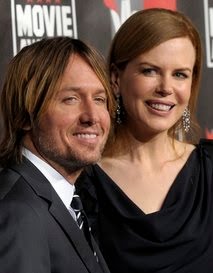
NASHVILLE, Tenn. – Nicole Kidman and Keith Urban have added a second daughter to their family, born through a surrogate mother.

The couple announced Monday the arrival of Faith Margaret Kidman Urban, born on Dec. 28 at a Nashville, Tenn., hospital.

Kidman and Urban released a statement saying they are "truly blessed" and thanked everyone for their support, "our gestational carrier" in particular.

The couple also has a 2-year-old daughter, Sunday Rose. Kidman credited her first daughter's unexpected appearance to swimming in the waters of a small Australian Outback town during the filming of "Australia." She and six other women became pregnant after swimming in Kununurra.